Skip to content Skip to navigation

Lemann Center Webinars

Austrália,Canadá e EUA inspiraram base curricular do Brasil

The Brazilian Government announced the Base Nacional Curricular (Common Core) program during the first week of April. If approved by the Congress until December, the document will have its implementation started in 2019. 

The national newspaper Folha de São Paulo published a series of special reports about the Base Nacional. In “Austrália, Canadá e EUA inspiraram base curricular do Brasil” ( Australia, Canada, and US inspired Brazilian Base Nacional Curricular) , Visiting Scholar Sabine Righetti explains how prior common core experiences from different countries inspired the Brazilian complex process to prepare the Base Nacional Curricular.

As summarized by Brazilianist and Lemann Center Director Professor David N. Plank, invited to analyze the Base Nacional implementation process and interviewd by Righetti, “There is no "average" or ideal length to the process--it depends on local conditions”, and “The quality of standards implementation matters more than the quality of the standards themselves” . 

Published by  Folha de São Paulo, via UOL on April 9, 2017.
'Em ciências, base curricular é trágica', avalia especialista de Stanford

The Brazilian Government announced the Base Nacional Curricular (Common Core) program during the first week of April. The national newspaper Folha de São Paulo published a series of special reports about the Base Nacional including an interview with Lemann Center Director Professor Paulo Blikstein in which he presented his perspective on the final document after his technical analysis.

The interview was given to Visiting Scholar Sabine Righetti, it is available  in Portuguese in this  link - Folha de São Paulo, via UOL.

School Vouchers are a “False Road”, and There’s Data to Prove it

Jeff Bryant writes about the negative impact of voucher programs on students’ educational attainment, which is the subject of Professor Martin Carnoy’s recent report “School vouchers are not a proven strategy for improving student achievement Studies of U.S. and international voucher programs show that the risks to school systems outweigh insignificant gains in test scores and limited gains in graduation rates” published by the Economic Policy Institute, EPI.

"When balancing the pros and cons of voucher programs, the “ultimate argument,” Carnoy explained to me, is that even if the effects of these programs are a wash, they divert resources and energy from more helpful programs, including high quality early childhood education, increased education funding, and teacher professional development focused on delivering better instruction."

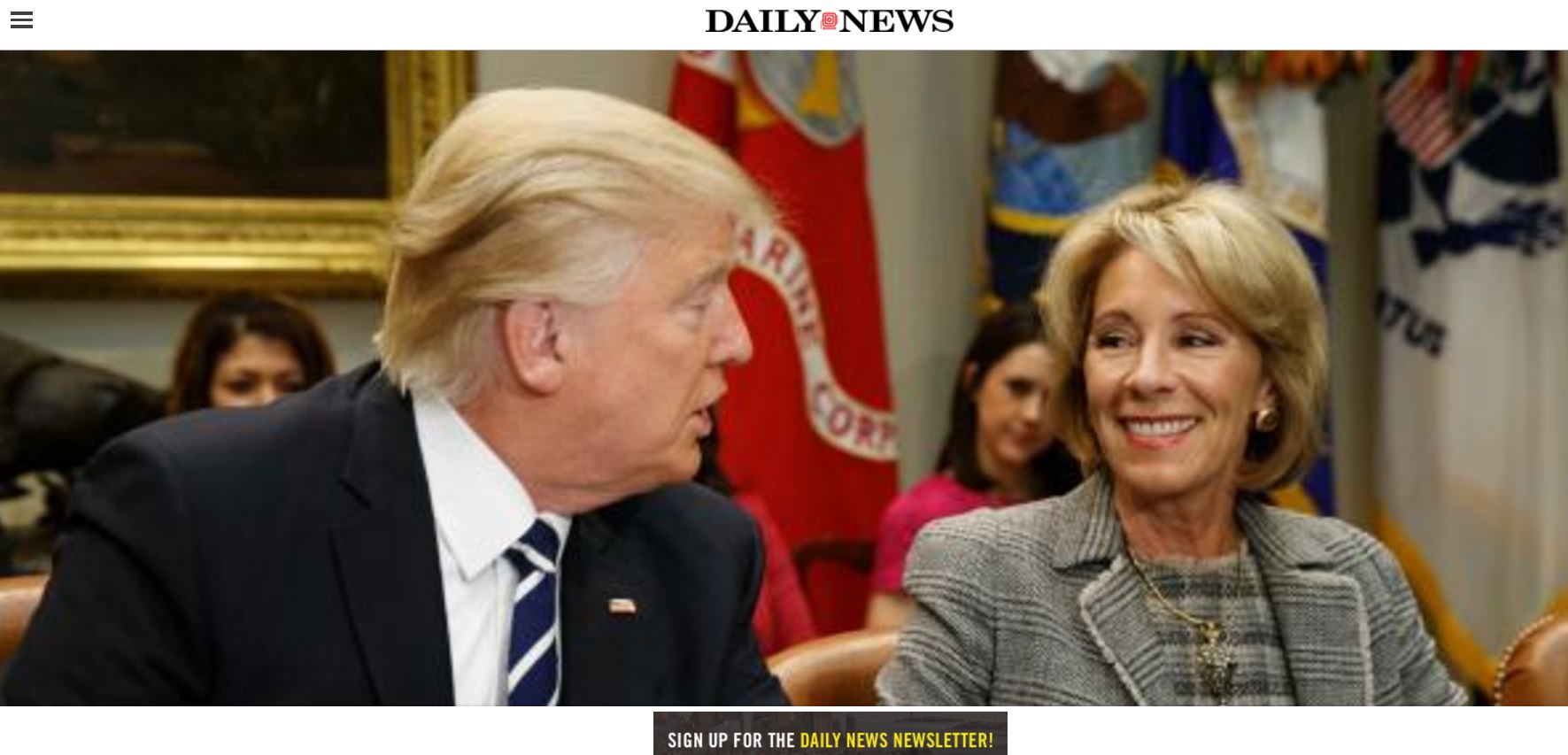
Trump’s school voucher con job: The President and Betsy DeVos talk up private school choice — but it doesn't help kids


" Donald Trump’s speech to Congress Tuesday night hardly mentioned education, but the little there was, was all about educational choice. The choice message was directed right at African Americans and Hispanics. “I am calling upon members of both parties to pass an education bill that funds school choice for disadvantaged youth, including millions of African-American and Latino children,” he said.

To dispel any doubt whether he was talking about the use of public money to attend private schools, the President pointed to a young black woman in the gallery, Denisha Merriweather. She had “struggled in (public) school and failed third grade twice,” he said. “But then she was able to enroll in a private center for learning, with the help of a tax credit scholarship program,” and went on to complete college." 

High School Reform in Brazil

Ensino flexível, mas chances iguais

A reforma do ensino médio deve respeitar a individualidade do aluno, guiar-se pela absoluta igualdade de oportunidades e oferecer conteúdos relevantes e atuais. A obrigatoriedade de todas as disciplinas é contraproducente, mas a flexibilização do currículo deve ser feita com cuidado. Por Paulo Blikstein*

“The main principle guiding the high school reform project should be to provide equal opportunities of access to higher education and to high status careers to all young Brazilians, regardless of social class”. Paulo Blikstein reviews the high school reform discussion in Brazil in a op-ed published by VEJA, one of the main weekly Brazilian magazines.  

Institutional Theory’s Past and Future Contributions to Organization Studies

The issue of BAR - Brazilian Administration Review, the international periodical of ANPAD (the Brazilian Academy of Management), v.13, n.3, July/September 2016, presents an interview with Stanford Emeritus Professor, W. Richard
 (Dick) Scott, who were interviewed by a former Lemann Center visiting student researcher, Juliana Marangoni Amarante.
 
Scott is currently Professor Emeritus of Sociology, with courtesy appointments in the Schools of Business, Education, Engineering and Medicine. He has spent his whole entire career at Stanford University. He is a leading contributor to
 organization and institutional theory and his empirical research has focused on professional organizations: schools, colleges, mental health systems, health care systems, nonprofit organizations and engineering teams.
 
Juliana is a PhD candidate in Business Administration at UEM - Universidade Estadual de Maringá, where she is advised by João Marcelo Crubellate. Last semester, she spent three months at the Lemann Center for Educational Entrepreneurship
 and Innovation in Brazil, doing part of her PhD dissertation, in which the institutional perspective is applied to comprehend universities' entrepreneurial turn. Given the proximity of her research to the studies conducted by Scott, Juliana's advisor while
 she was at Stanford, Professor Eric Bettinger, put her in contact with Scott and then, on May 2 2016, Scott kindly received Juliana in his Stanford Office to talk about Institutional Theory's past and future contributions to Organization Studies.

Single score is a misleading way to judge California’s schools

Imagine you are a judge on a cooking show. Every contestant prepares three different dishes, and you must choose the best cook. But different cooks are good at different things, so what measure can you use to judge them all?

That’s the question California lawmakers are grappling with in trying to rate schools. Historically, we’ve thrown all the things that schools do into a blender and judged the “soup” that comes out.

But that “soup” score misses a lot. It conceals what we know about schools’ true performance and gives them no guidance on how to improve. A few schools in California are bad at nearly everything, but most are good at some things even as they fall short in other areas. The blender approach mixes everything together – from average test scores to performance growth to graduation rates – and fails to distinguish one from another.

Jornal cita estudo de Vitor Pereira, economista e Fellow do Lemann Center em Stanford

Reportagem do jornal EXTRA, publicada em 13 de Junho de 2016, cita estudo do economista, Vitor Pereira que é Fellow do Lemann Center da Universidade de Stanford.

O texto de Bruno Alfano e Nelson Lima Neto, afirma: “A economia gerada pela suspensão do Renda Melhor Jovem, que pagava um prêmio por desempenho a estudantes de pequeno poder aquisitivo, para que concluíssem o ensino médio, se perderá por causa das repetências que o programa deixará de evitar. Essa é a avaliação do economista Vitor Pereira, doutorando da PUC-Rio e autor do estudo “Pagando estudantes para se formarem no ensino médio: evidências do programa Renda Melhor Jovem”.”
 

Paula Louzano participa do programa Missão Aluno da rádio CBN.

O comentário de Paula Louzano no programa Missão Aluno da rádio CBN trata da reforma curricular de Ciências nos Estados Unidos que tem a prática científica como ponto central e traça um breve paralelo com a reforma curricular brasileira. 

Acompanhe a entrevista publicada originalmente pelo site da CBN/GLobo.com.

Paula Louzano talks about Common Core in the Sciences in the United States and its similarities and differences compared to the Brazilian Common Core (Base Nacional, BNCC). The interview is in Portuguese and available at this link below.

Implementation of the BNCC - Movimento Pela Base Nacional Comum

The Brazilian organization "Movimento Pela Base Nacional Comum (Movement for the National Common Base)" has featured Stanford Professor and Lemann Center Director David Plank's research on the implementation of the common core education system in Brazil, and what lessons we can gain from its implementation in the US.

Pages