

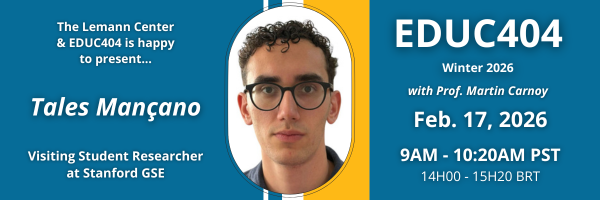
About the presentation:
Over the past 30 years, Brazil experienced what scholars call the "second great cycle" of tertiary education expansion. Enrollment surged from 1.6 million to over 10 million students—a more than sixfold increase. During this period, policies aimed at equalizing access opportunities were intensely debated and implemented, including: need-based scholarships for low-income and public school students; expansion of subsidized student financing; creation of public universities in underserved regions; regulation and flexibilization of private and distance education that enabled private sector growth; and affirmative action quotas in public universities. These policies plausibly transformed patterns of access inequality. This research investigates how inequality in access to higher education evolved during this expansion, seeking to advance theoretical understanding of how access to a core public service—education—can be (re)distributed in a context marked by an immensely dualized and diversified system that serves a relatively small proportion of the college-age population, with a large private for-profit sector and particularly acute ethnic and socioeconomic inequalities.
About Tales:
Tales Mançano is a graduate student in Political Science at the University of São Paulo (USP). His research focuses on educational policy and inequality, and comparative political economy, particularly examining how different institutional designs of the welfare state impact inequalities in Brazil and Latin America. He is interested in how distinct institutional schemes shape educational inequalities and the distributional conflict across countries and over time. He is a researcher at the Center for Metropolitan Studies (CEM), was a visiting researcher at the "Politics of Inequality" Cluster at the University of Konstanz and currently a Visiting Student Researcher at the Lemann Center, Stanford Graduate School of Educatio
Click the link below to view the presentation:
