

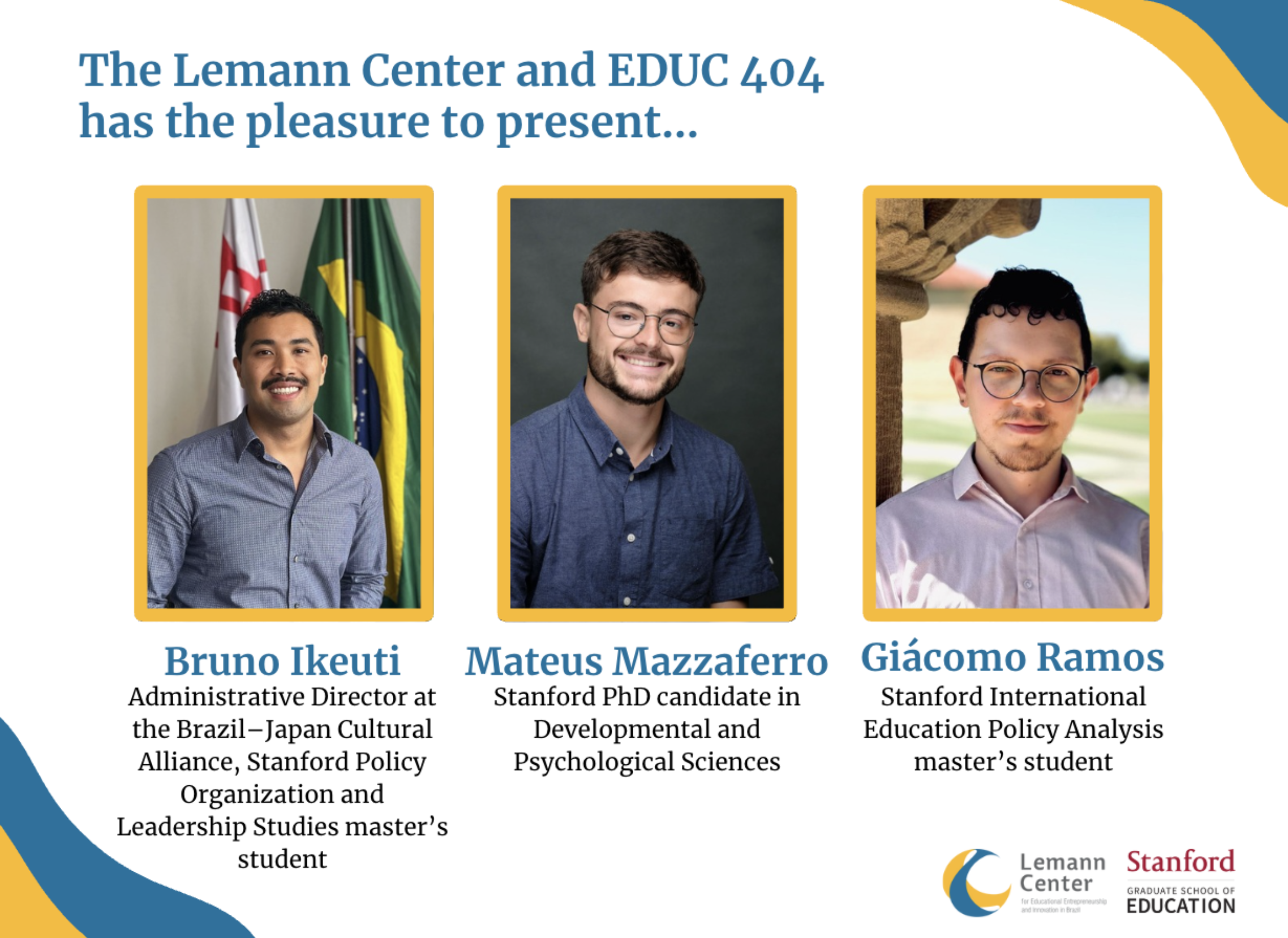
GSE Student Presentations
Bruno Ikeuti
Bruno Ikeuti is the Administrative Director at the Brazil–Japan Cultural Alliance. He previously served as Coordinator at the São Paulo City Council and as Special Advisor at the São Paulo State Department of Education. He holds a Master’s degree in Entrepreneurship and a Bachelor’s in Business Administration from FEA-USP, with an academic exchange in History at Paris IV Sorbonne. He is currently pursuing a Master’s in Policy, Organization, and Leadership Studies at Stanford University. He is the founder of the NGO FEA Social and an ambassador for the France Alumni network.
About the presentation
Code for America works to make government services more accessible to all citizens. In partnership with the federal government, the organization launched a free tool to help low-income and Gen Z Americans file their taxes. While millions of Americans missed the opportunity to receive a refund this year because they didn’t file their taxes, most of those who did still used paid services. This summer, I will be responsible for developing Code for America’s marketing strategy to identify the best channels for each stage of the decision-making process, and to craft the most compelling messages for each step of the marketing funnel.
Mateus Mazzaferro
Mateus Mazzaferro is a PhD candidate in Developmental and Psychological Sciences at Stanford University’s Graduate School of Education. Originally from São Paulo, Brazil, his research is driven by a deep interest in how environmental inequality shapes child development. He holds a BA in Psychology from Humboldt University of Berlin and an MA in Psychology and Education from Teachers College, Columbia University. His work focuses on the neuropsychological development of children in underserved communities, with the goal of informing policies that promote equitable opportunities for all children to thrive.
About the presentation
This presentation investigates whether reading ability moderates the relationship between math fluency and math test performance among Brazilian primary school students. The study finds that students with lower reading skills tend to underperform on math tests despite having comparable math fluency, due to reading demands embedded in test items. These findings raise concerns about test fairness and suggest that current assessments may underestimate math potential in disadvantaged or low-literacy populations.
Giácomo Ramos
Giácomo is an MA student in the International Education Policy Analysis program at the Stanford GSE. His research focuses on education for democratic citizenship. In particular, he analyzes the conceptualizations of "ideal citizenship" promoted by different social institutions in the context of polarization and democratic backsliding with the goal of comprehending these institutions' perspectives on democracy. Giácomo holds a BA in Political Science and Anthropology from the University of Chicago and has professional experience in college admissions. He plans to return to his home state of Rio Grande do Sul upon graduating from Stanford.
About the presentation
To improve public support for democracy, civil society organizations around the world (e.g., in Brazil, Chile, and the UK) have been creating citizenship education programs that are inserted into public schools through partnerships with the government. In Brazil, the NGO Politize! has established partnerships with 8 state secretariats of education, mostly in states led by conservative right-wing parties. In this context, what is the version of "ideal citizenship" promoted by Politize! and the secretariats, and what types of "ideal citizen" are left out? What do the adoption and adaptations of Politize!'s programming by bureaucrats tell us about the possibilities and limitations of education for democratic citizenship in Brazil? This study aims to answer those questions qualitatively through the analysis of documents and interviews, arguing that justice-oriented citizenship is attenuated or left out of Politize!'s programming due to a fear of retaliation.
