

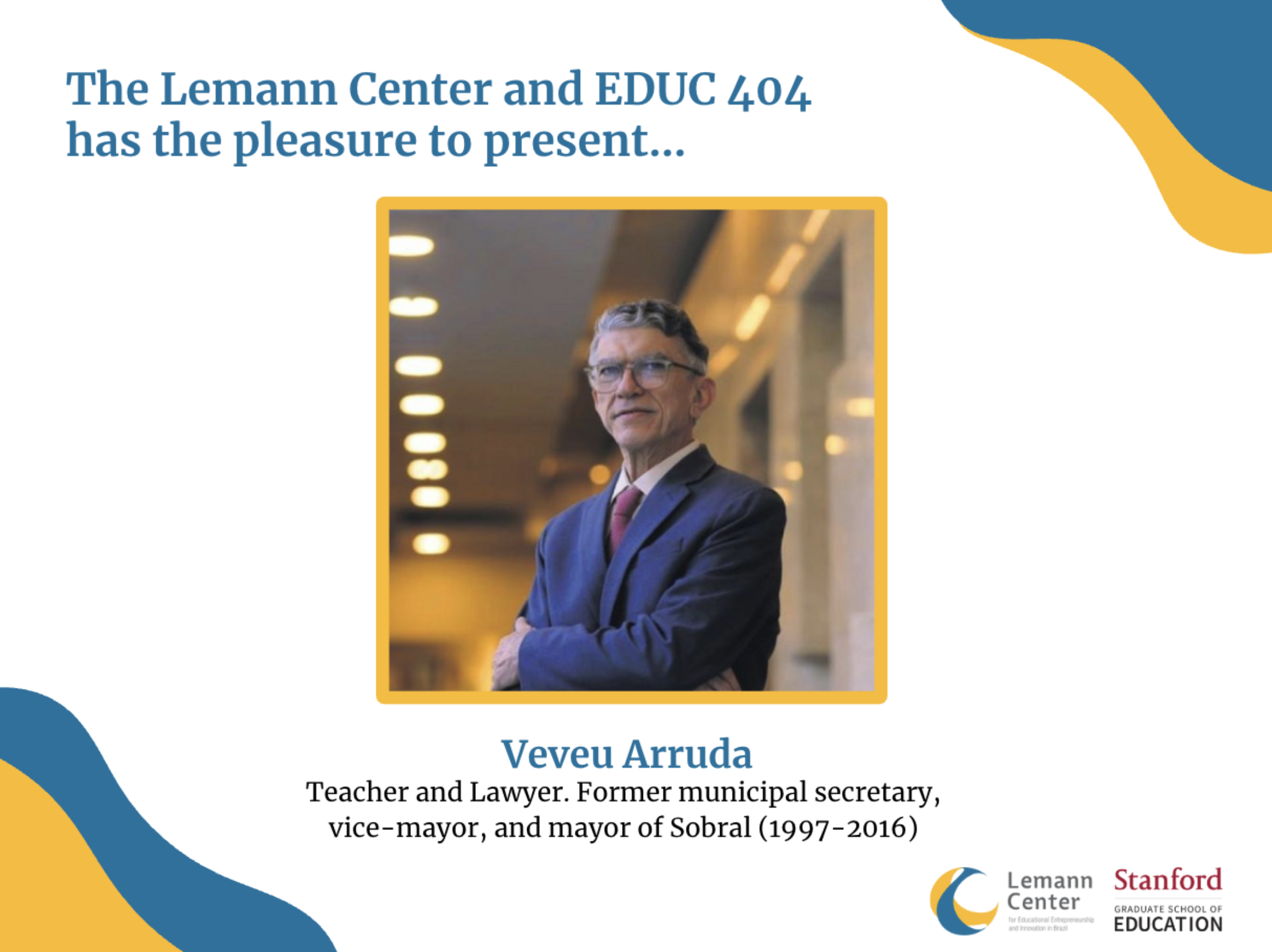
Veveu Arruda
Teacher and lawyer, Veveu Arruda was municipal secretary, vice-mayor, and mayor of Sobral (1997-2016). During his tenure, the municipal education network was evaluated as the best in the country, according to the Basic Education Development Index (Ideb), with the highest index in Brazil (8.8), among over 5,500 Brazilian municipalities. He was a visiting researcher at Columbia University and is currently the president of the Bem Comum Association (ABC). The non-profit institution works in partnership with the Lemann Foundation and the Instituto Natura, supporting municipalities and states in Brazil in the design and implementation of policies to improve learning, with an emphasis on children's literacy, inspired by the experiences of the municipality of Sobral and the state of Ceará.
About the presentation
We can affirm that for 50 years, in Sobral, there was no Educational Public Policy, or what existed did not ensure the learning that a school network should guarantee for the people who studied in them. In Sobral, 24 years ago, public schools produced illiteracy. The political-party alliance that was formed for the 1996 elections, for the first time in Sobral's history, was based on a document that affirmed the need to overcome a political culture of privileges with a political culture of Rights and Duties, with the definition of concepts, methods, and priorities. One of the main pillars of this new political edification was exactly the central priority of elaborating an Educational Public Policy that effectively guaranteed student learning, based on 4 main dimensions: a. excellence in learning; b. equity; c. citizen formation, which offered students the possibility of transforming themselves to have a dignified and decent life, and at the same time, be a protagonist of changes around them; and d. preparation for practical life and work.
Political decisiveness, management strategies, and pedagogical strategies transformed public schools into a relatively positive learning network over the past few years. In 2016, the learning results achieved by the Sobral public network made Sobral reach the best IDEB among all 5,574 municipalities in Brazil.
From 2007 onwards, this experience served as a reference for the Government of the State of Ceará, under the leadership of Governor Cid (former mayor of Sobral) and State Secretary of Education Izolda Cela (former Secretary of Education of Sobral), to establish a new State Public Policy through the Collaboration Regime with the 184 municipalities. In November 2016, when I was Mayor of Sobral, I received a visit from Mr. Jorge Paulo Lemann, other members of the Lemann Foundation Council, and some of its main leaders. At the end of 2017, Mr. Jorge Paulo challenged me: "Are you willing to organize a program that takes the Sobral experience to other Brazilian municipalities?" We began working on this project in early 2018, still at the Lemann Foundation. We then created the Bem Comum Association, started a partnership with the Lemann Foundation, and later with the Instituto Natura. Initially, we went to one municipality in 5 different states, contributing to the early years of elementary school. In 2019, we added 4 more municipalities in the same states through a selection process.
With accumulated experience, in April 2019, we began working with the first states using the Collaboration Regime strategy with a focus on literacy. Today, we are in 18 Brazilian states, reaching 3.5 million children, in 3,994 municipalities, 253,000 teachers, and 55,617 schools.
Over time, even relatively, we contributed to the new Fundeb Law, especially with the constitutional requirement for all states in the federation to implement the Educational ICMS Law, the percentage of 2.5% of Fundeb resources for federated entities that effectively comply with learning, equity, and the appointment of educational leaders with skills and competencies, rather than political appointments.
It is about the effectiveness of the interfederative collaboration regime, with management and pedagogical strategies, to guarantee the overcoming of the Brazilian tragedy of child illiteracy that I intend to share and reflect with those present in the next Tuesday's class, on the 20th.
Reading
Cunha e Melo, M. F. P., Burgos, M.T.B., Bellato, C., Palácios, F. Introdução. In: Para alfabetizar na idade certa: Protocolos para a organização de uma política de formação continuada e de incentivo ao compromisso com os resultados para professores alfabetizadores. (2019) ENG PT
Abrucio F. L., Seggatto, C. I. & Pereira, M.C.G. Disseminação do Modelo Colaborativo Cearense: propostas de indução institucional para o federalismo brasileiro. In: Regime de Colaboração no Ceará: Funcionamento, causas do sucesso e alternativas de disseminação do modelo. p. 67-69. PT ENG
Short video: Parceria pela Alfabetização em Regime de Colaboração (Fundação Lemann, Instituto Natura e Associação Bem Comum) Link
