

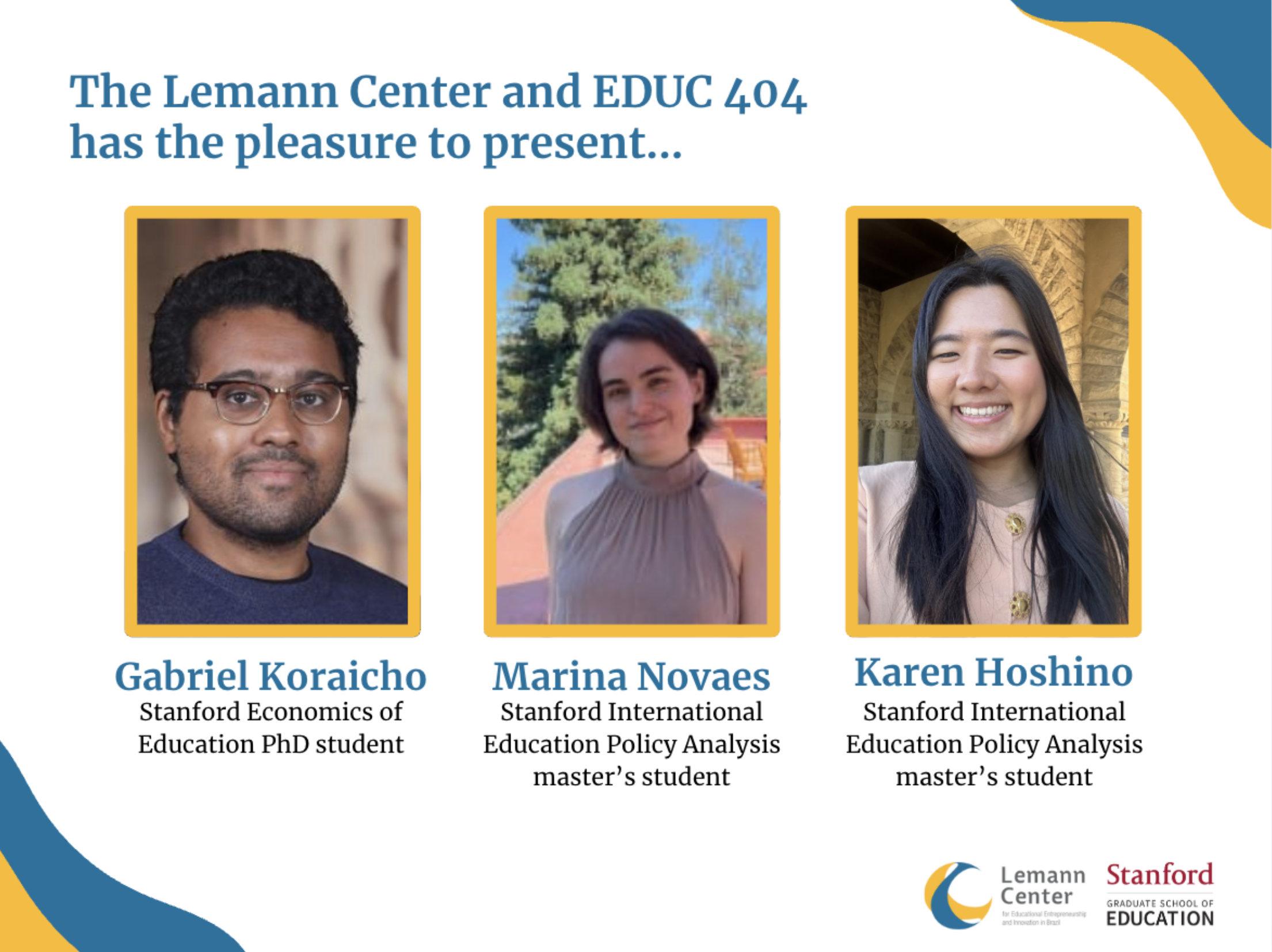
Gabriel Koraicho
Gabriel Marcondes Koraicho is a Ph.D. candidate in the Economics of Education program at Stanford GSE. He holds an MSc in Economics from Fundação Getúlio Vargas - Escola de Economia de São Paulo (FGV-EESP) and a BA in Economics from Universidade de São Paulo (USP). His research focuses on understanding the main barriers students from public high schools in Brazil face during their transition from basic to higher education and the mechanisms that influence it. Gabriel is interested in quantitative methods to evaluate public policies, focusing on education, inequality, and higher education.
About the project
This project analyzes survey data from around 200,000 high school students in São Paulo state from 2024, focusing on identifying the main barriers that public school students face when deciding whether to pursue higher education. The study investigates how factors such as gender, race, parental education, financial constraints, and information correlate with students' decisions to apply for college. The survey happened in parallel with the 'PREPARA SP' project, an initiative designed to engage students applying for entrance exams such as the ENEM. By examining these key challenges, the project aims to provide insights into the barriers disproportionately affecting underrepresented groups, contributing to discussions on improving access to higher education in Brazil.
Marina Novaes
Marina Novaes is a Master's student in International Education Policy Analysis at Stanford Graduate School of Education and a 2024 Person of the Year Fellow. Her research focused on the evolution of digital education policies in Brazil. She holds a BA in International Relations from the University of São Paulo. Marina has previous experiences at Ensina Brasil, including partnerships, fundraising, network engagement and career development in education. Marina is interested in fostering collective efforts and effective resource articulation to advance quality education in Brazil
Karen Hoshino
Karen was born in Japan and raised across Latin America (including Nicaragua, Ecuador, and primarily Brazil). She holds a B.A. in International Studies and Spanish from Saint Louis University and earned a master’s in Latin American Studies from Stanford University in 2024. Now a Lemann Fellow pursuing a second master's in international education policy at Stanford, Karen’s academic journey has focused on international student mobility, ethnicity, and race in education. Her current research explores AI policies in higher education institutions in the U.S. and Brazil, analyzing how these frameworks reflect broader socio-political and geographical dynamics and highlighting disparities in AI integration between the Global North and South.
About Marina and Karen's presentation
Our study examines Brazil’s evolving digital education policy, tracing its development from the 2014-2024 National Education Plan (PNE), which lacked references to digital education, to the newly approved 2024-2034 PNE, which integrates digital literacy, infrastructure, and educational technology as priorities. This policy shift results from changes in stakeholder perspectives, technological advancements, and the impact of the COVID-19 Pandemic. We explore key actors, turning points, and challenges in overcoming the digital divide, particularly among marginalized communities. This research provides insights into how targeted policies influence national strategies by examining various stakeholders’ roles in policy evolution. The study also contributes to the broader discussions on digital education governance, offering lessons for policymakers navigating technological integration in education worldwide. Ultimately, our work uses process tracing to understand how digital education became a national priority, illustrating how Brazil’s case sheds light on the broader mechanisms through which nations, especially in the Global South, respond to emerging educational needs, political agendas, and technological progress shaping both short and long-term policy frameworks.
